
Touch, Hands-On Therapy and Pain: When It Helps, When It Doesn't, and Why It's Complicated
Nov 11, 2026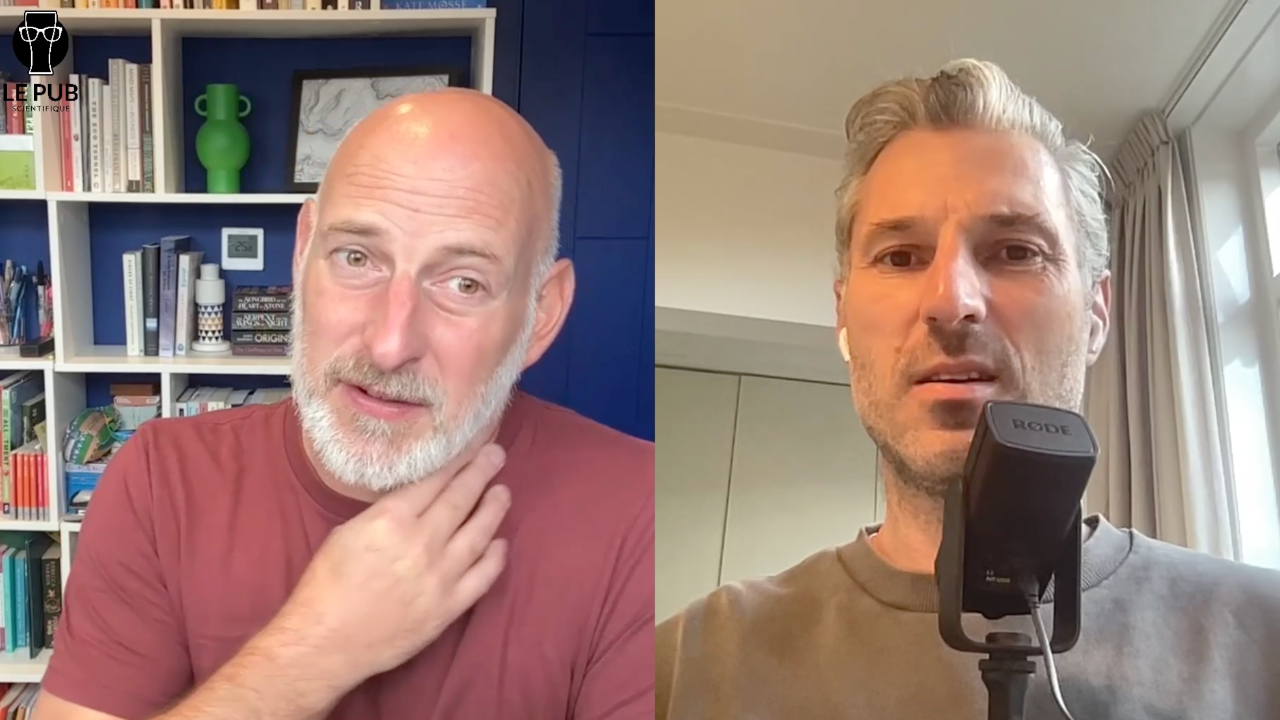
By Tim Beames & Bart van Buchem | Le Pub Scientifique
The first time Bart places his hands on a patient with a stubborn tremor, something strange happens. The shaking simply stops. Not because he has pushed it away or fought it into submission, but because his touch has given the nervous system somewhere else to put its attention. The patient sits quietly and looks down at their own still hand as though it belongs to someone else. And then comes the question that matters more than the tremor stopping. How does that feel?
Contrast that with another kind of moment, one many physiotherapists know less comfortably. A patient arrives eight weeks into treatment. In session one, hands-on work brought dramatic, almost instant relief. Today they are asking whether they could come in twice a week instead of once, because whatever happens between sessions isn't holding. Same profession, same pair of hands, wildly different trajectory.
This is the territory Tim and Bart set out to map in this episode. Touch and manual therapy, when they help, when they don't, and why the honest answer to "does manual therapy work" refuses to sit still.
Touch as information, not correction
Before anyone reaches for a technique, Bart makes a point that reframes the whole conversation: touch starts long before hands ever land on skin. It starts implicitly, with a handshake, with the way someone responds to the invitation into a clinical assessment. And crucially, it starts with permission. Bart describes asking people directly whether they're comfortable with touch, and the answers surprise him in both directions. Some people who you'd expect to welcome it flatly refuse. Others say yes without hesitation. There is, in his words, a license to touch, and it has to be earned and checked rather than assumed.
What that license buys you, when it's granted, is information. Not just about tissue, but about a person's relationship with their own body. Tim shares a recent example: a patient he was working with methodically, comparing sensation from one area to another, asking repeatedly how something felt in comparison to a moment ago. The patient paused and asked whether anyone had done this with them before. They'd certainly been touched by other therapists, but never asked so much about how it actually felt. That small shift, from being handled to being consulted, is where touch starts doing something different than simply applying a technique.
Bart pushes this further with an idea worth sitting with: you can't tickle yourself. A third person's touch will always carry information that self-touch cannot, because it comes from outside your own predictions about your own body. That's part of why touch is such a useful diagnostic tool, and part of why it has to be handled carefully. It also means that before any hands-on treatment begins, there's already a great deal to learn simply by asking how touch has been experienced in the past, including whether previous contact ever triggered a delayed flare, which can point toward a different clinical picture entirely than a straightforward, localised soreness would.
Reading the touch profile
Bart talks about developing a sense of a patient's touch profile, an understanding of how their system responds to different kinds of contact before you commit to a plan. This matters clinically because different pain presentations respond to touch in recognisably different ways. Neuropathic pain tends to show a stable, predictable pattern. Gentle touch that shouldn't hurt does, a light brush produces genuine allodynia, and a small pinprick provokes pain wildly out of proportion to the stimulus. Test it ten times and you'll likely get a broadly consistent picture, distributed along a nerve's territory.
Nociplastic presentations behave differently. Test the same area ten times and you may get ten different answers. The distribution shifts, sensitivity comes and goes, and what was painful yesterday might not be today. That inconsistency isn't a sign that something is being missed or exaggerated. It's a feature, and recognising it as one is part of reading the profile accurately, especially since the two pictures can and often do overlap in the same patient.
None of this requires assuming anything about what's found. Bart is clear that concluding a muscle is "tight" or a joint is "stuck" based on what your hands feel, without checking that against the patient's own experience, is a habit worth dropping. What your hands notice belongs in your clinical reasoning. It doesn't automatically belong in the words you hand back to the patient.
When touch gives agency back, and when it takes it away
The clearest illustration of touch doing real work comes from Bart's experience with functional neurological disorder. Some FND presentations feature a tremor or involuntary movement, and a very specific, very light touch, in the right place, at the right moment, can bring it to an immediate stop. What matters afterward is what happens to that moment. Bart resists the framing of touch as "fixing" the tremor and pushes instead toward a different question: how does it feel to have agency over this? The aim isn't for the patient to depend on his hands to interrupt the movement. It's for that instant of stillness to become something the patient can access themselves, sometimes even by visualising the same sensation without any touch at all. Used this way, touch becomes a doorway back to a sense of control that pain, or in this case a movement disorder, had taken away.
Tim offers the other side of that coin, drawn from his work with people living with complex regional pain syndrome. Where FND touch can restore a sense of ownership, CRPS can present the opposite risk. Tim describes cases where a well-intentioned attempt to move an affected limb, offered as a way of rebuilding agency, was met instead with a dramatic and distressing response. Sudden, severe pain. Visible changes in the limb's colour, happening in front of his eyes. The intention was the same as in the FND example, restoring a sense of control over the body, but in a system that sensitised, the same gesture landed as an intrusion rather than an invitation. Tim's practical response is to never begin touch at the most affected area. He establishes a baseline first, understanding how a patient experiences touch elsewhere on their body, in less affected territory, before considering whether and how to approach the area that matters most to them.
Bart adds a related observation from working with cervical dystonia, where an involuntary turning of the head can sometimes be interrupted almost instantly by the lightest possible touch to the chin or cheek, a phenomenon known as a sensory trick. What's notable is that it works better gentle than forceful. Pushing hard against an involuntary movement, in his words, risks treating trauma with new trauma. For a nervous system that's already sensitised, force rarely produces the kind of change that lasts.
Reading dependency before it becomes a pattern
The conversation closes on a question every manual therapist eventually has to sit with: how do you know when hands-on treatment has become something a patient depends on, rather than something that's genuinely helping them move forward? Bart's answer isn't about a single session going too well. It's about a shape that emerges over time. The first few sessions produce something close to magic, real and significant relief. Then, session by session, the effect gets smaller and doesn't last as long. The patient starts asking for more frequency, not because the underlying problem has changed, but because the gap between sessions has become harder to tolerate. Bart is careful not to frame this as a moral failing on anyone's part, either the therapist's or the patient's. It's a predictable curve that shows up across almost any passive intervention repeated on its own, whether that's manual therapy, dry needling, or acupuncture. Relief peaks early and diminishes with repetition unless something else is being built alongside it.
The distinction that matters clinically isn't whether to use touch again. It's whether the patient is developing anything else, any sense of self-management, any tool that doesn't require someone else's hands, in parallel. For some conditions and some people, ongoing hands-on treatment may genuinely be the most appropriate option available. For others, noticing that pattern early is the signal to widen the approach before the relationship with manual therapy narrows into the only thing that's tried.
Where this sits in the bigger picture
This conversation connects directly to threads the series has been building. The question of whether touch restores or erodes a sense of control sits right alongside the agency work from earlier episodes, where the same tension shows up in how people relate to their own bodies more broadly. The dependency pattern Bart describes is really a dosing problem in disguise, too much of one input repeated without enough variation or self-directed practice alongside it. And the underlying principle, that manual therapy earns its place as a source of information and a route into agency rather than as a fix in its own right, echoes something Phil Harris described from a very different angle in the functional breathing series, where hands-on work created space for a system to do something it couldn't do unassisted, rather than doing the work for it.
A closing thought
Asked to keep exactly one justification for using touch and let everything else go, Bart didn't reach for technique or evidence. He said touch is how humans communicate. It's a natural part of how we learn about the world and about each other, and in a clinical setting, that's still what it's doing. The debate over whether manual therapy "works" often gets stuck arguing about mechanism, when the more useful question might be a simpler one. What is this touch actually communicating to this particular nervous system, right now, and is it building something that will still be there once your hands are gone?
This blog is based on an episode of The Pain Podcast by Le Pub Scientifique. Listen to the full conversation on Podbean, Spotify, or Apple Podcasts. For clinical action plans, treatment guides, and our full library of science sessions, visit lepubscientifique.com.
Le Pub Scientifique is where pain treatment gets real. We gather the world's most respected clinicians and researchers to share practical strategies that work. No boring theory, just proven techniques from clinicians who get remarkable results.
Stay connected with news and updates!
Join our mailing list to receive the latest news and updates from our team.
Don't worry, your information will not be shared.
We hate SPAM. We will never sell your information, for any reason.