
When Pain Takes Over: Reclaiming Agency and Ownership of Your Body
Jun 19, 2026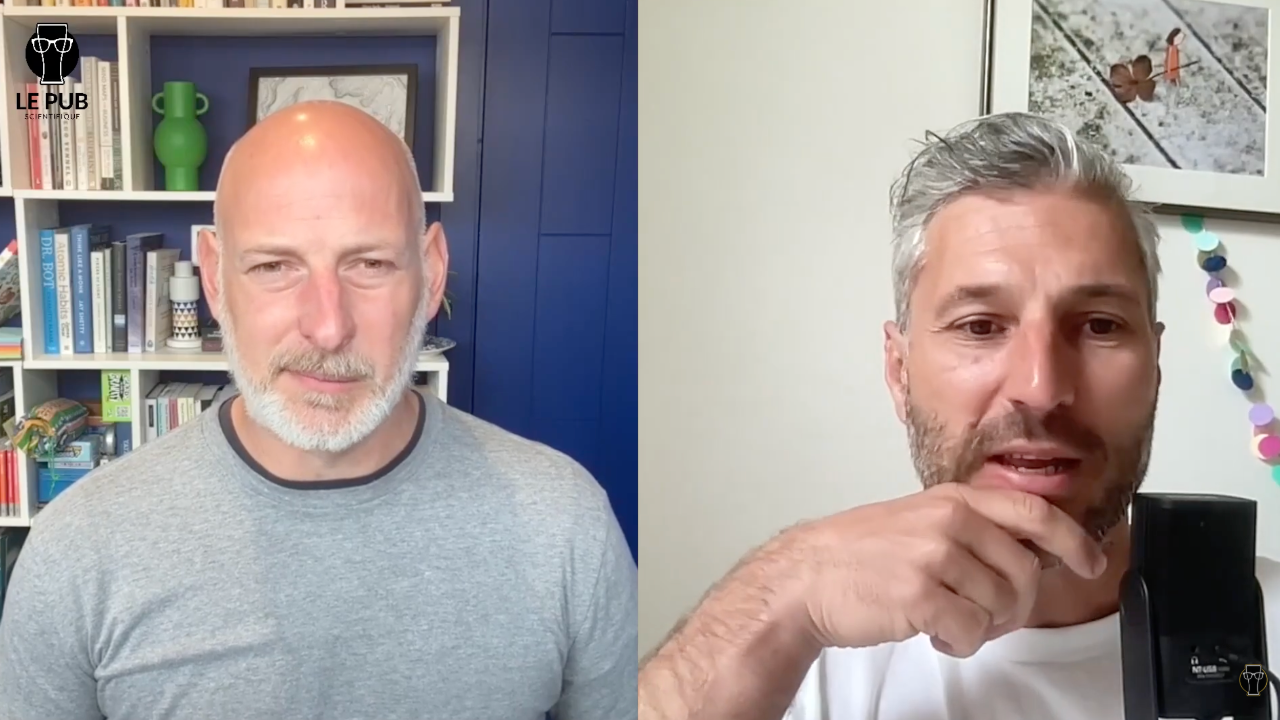
By Tim Beames & Bart van Buchem | Le Pub Scientifique
There's a moment in clinic that most pain clinicians will recognise. A patient looks at you and says something like: "I just want to get rid of my leg." They don't mean it literally — they know they need the leg — but the language tells you everything about where they are. The pain has become so bound up with that body part that the two are inseparable. The leg isn't theirs anymore. It belongs to the pain.
This is what it looks like when agency flips. When the person is no longer the one in control — when pain becomes the agent, dictating what's possible, what's safe, and what life looks like from here.
In a recent episode of The Pain Podcast, we explored this territory in depth: what agency and ownership actually mean in persistent pain, how they show up (and break down) in the clinic, and what we can do to help people reclaim them. What follows draws on that conversation, grounded in real clinical scenarios we've encountered.
Agency and ownership: related but not the same
It's worth pulling these apart. Ownership is the sense of being a body — of feeling whole. You need to feel that your painful knee, your aching back, your throbbing arm is actually yours before you can do much with it. Agency is the sense of being in control — of being the one who decides how and when you move, and what your life looks like.
They often travel together, but not always. Someone might still feel a body part is "theirs" but feel completely powerless over it. And someone might feel disconnected from a limb — referring to it as "the leg" or "it" — while simultaneously being hypervigilant about every sensation it produces.
That paradox is worth sitting with. How can you feel disconnected from something you can't stop monitoring?
The self-monitoring trap
We see this pattern constantly. A person says the painful area doesn't feel like them anymore, and yet they're checking it all the time. Walking to school, sitting at work, lying in bed — testing, scanning, noticing. Does it still hurt when I do this? What about now? Is it worse than yesterday?
This isn't a contradiction. It's what happens when the brain gives greater weight to the difference between what a body part should feel like and what it does feel like. The more you check, the more you notice the gap. The more you notice the gap, the less it feels like you. And the less it feels like you, the more you check.
It's a perceptual action loop, and it can be deeply self-reinforcing. Over time, people become extraordinarily detailed in describing their symptoms — not because they're catastrophising, but because their attentional system has become finely tuned to that part of the body. They notice things most people would never register.
When the outside world makes it worse
There's another layer to this. When someone is already in a heightened state of body-monitoring, they become more susceptible to external suggestion. An X-ray image shared on social media. A well-meaning clinician who says "your spine is out of alignment." A friend who had the same symptoms and was told it was degenerative.
In a state of uncertainty — I've tried everything, nothing works, nobody can tell me what's wrong — these messages land differently. They land harder. And once someone believes their disc has "burst" or their spine is "out of line," they may start to feel exactly that. The suggestion shapes the experience.
This doesn't mean the experience isn't real. It absolutely is. But it does mean that what people feel is being shaped not only by what's happening in their body, but by everything they've been told, shown, and led to believe about it. And that's something we can work with.
Clinical scenario: the woman who stopped wearing makeup
One of the most striking examples of ownership loss — and recovery — came from a patient Tim saw earlier this year. She wasn't talking about pain levels or movement limitations. She was talking about makeup.
She told him she'd lost all interest in looking at herself in the mirror. Getting ready in the morning had become a chore she skipped. She didn't care what she looked like because her body didn't feel like something worth caring for.
And then, gradually, something shifted. She started experimenting with different colours. She spent time in front of the mirror again — not checking for symptoms, but reconnecting with her own image. She noticed she was enjoying it.
This wasn't a prescribed exercise. Nobody told her to do it. But it was a profoundly important marker of recovery — she was taking back ownership of her body image, re-engaging with herself as a whole person rather than a collection of painful parts.
For clinicians, this kind of moment is easy to miss if you're only tracking pain scores and range of motion. But if you're listening for it — if you understand that recovery from persistent pain often looks like someone reconnecting with who they are, not just what they can do — then it's one of the most meaningful signals you'll get.
What we can actually do: strategies for rebuilding agency and ownership
So how do we help? The honest answer is that there's no single technique. But there is a way of thinking about it, and a set of tools that fit within that thinking.
Start by making it explicit. This sounds simple, but it's often the first step: pointing out what you're observing. "Do you feel like that leg is really part of you right now?" or "It sounds like your body doesn't feel like it's on your side at the moment." Making the implicit explicit gives people language for something they may have felt but never articulated. It also opens the door to working on it together.
Graded motor imagery. GMI fits beautifully here because it works on re-familiarising the brain with the existence and possibilities of the affected body part — initially at a subconscious level through laterality recognition, then through imagined movement, and finally through visual feedback. It's a structured way of bringing a disconnected body part back into the whole.
Mirror therapy — done well. Mirrors are powerful, but they're often misused. The visual system dominates our perception, and when a mirror presents a reflection of the unaffected limb where the painful one should be, the brain can prioritise that visual information over the proprioceptive and interoceptive signals it's receiving from behind the mirror.
The result, when the illusion is believable, can be remarkable. People report feeling sensation in the hidden limb. They see movement that looks freer, easier, less restricted — and that visual evidence starts to open up what feels possible.
But this requires careful setup. If the illusion isn't plausible — if the positioning is off, the limb doesn't look right, or the person isn't ready — it falls flat or worse, it feels threatening. Tim's approach is to frame it as an experiment: "Would you be interested in exploring something with a mirror? I'm curious what you'll notice." Ask what they expect to see, what they expect to feel. Then let the experience do the work.
For spinal pain, get creative with visual feedback. Mirror therapy doesn't translate easily to the back. But visual feedback still matters. Setting up a laptop camera behind someone so they can watch themselves move in real time, or simply taking a short video of their back and showing it to them, can be surprisingly powerful. Many people with back pain have never seen their own back move. They assume it looks damaged, fragile, broken. Seeing it move — and seeing it look... normal — can shift something.
Reflect, don't just do. Exercise alone isn't enough. If someone does a squat in the gym but doesn't notice how it felt, whether it was different from last time, whether one side felt more connected than the other — they've missed the point. The reflective piece is where agency lives. It's the difference between doing a movement and being the person doing the movement.
Build health literacy for the long term. The ultimate goal isn't to make someone dependent on you. It's to leave them in a better position to make wise decisions about their body and their health if problems come back in the future. Education that reduces fear, builds understanding, and gives people a framework for interpreting their experiences — that's agency that outlasts the therapeutic relationship.
Pacing the work: what the clinic needs to feel like
None of this works if the therapeutic environment doesn't feel right. From our experience, there are a few non-negotiables.
It needs trust. Experiential work — mirror therapy, movement experiments, anything that asks someone to engage with their body in a new way — requires a therapeutic alliance. People need to feel safe before they can be curious.
It needs pacing. You can't rush someone into a mirror exercise on session one if they're not ready. Equally, you can't let caution become avoidance. The skill is in reading where someone is and meeting them just beyond it — creating a small enough surprise that it updates their predictions without overwhelming them.
It needs to be meaningful. A technique that doesn't connect to someone's life, values, or goals is just a technique. The context matters. Why are we doing this? What does it mean for the things you care about? Those questions should be close to the surface throughout.
And it needs to tolerate discomfort. Some of this work will feel strange, unfamiliar, even unsettling. That's not a reason to stop — it's a sign that something is being challenged. Being there for someone through that, guiding without pushing, is part of the job.
A final thought
Agency isn't about forcing your body to behave. It's about rediscovering that participation is possible — that you are still the one living in this body, and that what feels available to you right now is not all that will ever be available.
For clinicians, the invitation is to look beyond the symptom and ask a different question: not just what hurts? but who is in charge here? Because when someone starts to feel like the answer is "me again" — even tentatively, even partially — that's when things begin to change.
This blog is based on an episode of The Pain Podcast by Le Pub Scientifique. Listen to the full conversation on Podbean, Spotify, or Apple Podcasts. For clinical action plans, treatment guides, and access to our full library of science sessions, visit lepubscientifique.com.
Le Pub Scientifique is where pain treatment gets real. We gather the world's most respected clinicians and researchers to share practical strategies that work. No boring theory, just proven techniques from clinicians who get remarkable results.
Stay connected with news and updates!
Join our mailing list to receive the latest news and updates from our team.
Don't worry, your information will not be shared.
We hate SPAM. We will never sell your information, for any reason.