
Who Looks After the Clinician? Burnout, Doubt and Staying Well in Pain Care
Oct 14, 2026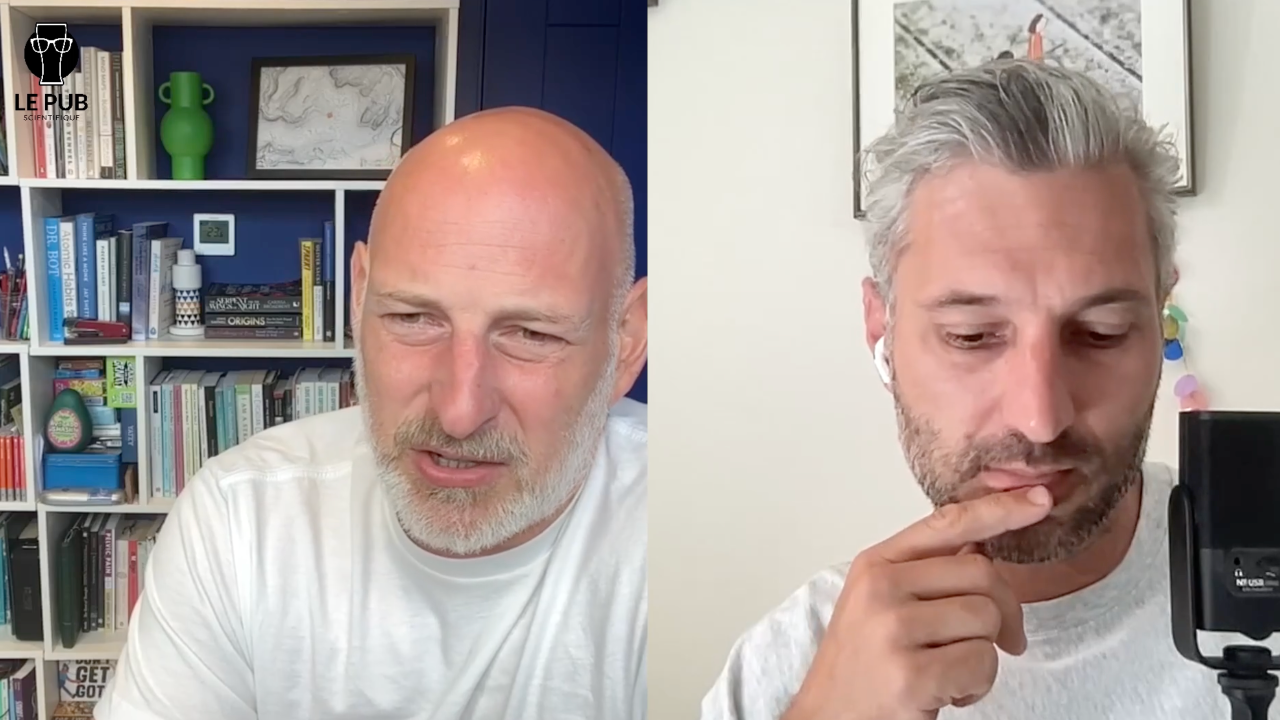
By Tim Beames & Bart van Buchem | Le Pub Scientifique
There's a particular kind of session that stays with you. Not because it was traumatic, but because nothing landed. You tried everything you knew. You reached for connection and couldn't find it. The patient left and you sat there thinking: what just happened? Did I miss something? Am I actually any good at this?
That feeling, for most pain clinicians, is familiar. It's also almost never discussed.
Over the last five episodes of The Pain Podcast, we've explored how to create safety for patients, how to expand their world, how to bring play and creativity into rehabilitation, and how to dose it all carefully. This episode, we turned the lens around. Because everything we've said about dosing, affordances, and sweet zones applies to clinicians too. And if you're running on empty, none of the other stuff works.
This is personal
We started this conversation with full disclosure. Bart, at forty-three, has noticed his body talking to him more than it used to. Recurrent back pain episodes. Sleep that comes and goes. Energy that fluctuates in ways he can now clearly link to how he's working and whether he's looking after himself. He describes it as waves. He knows he'll be all right when he manages them. But managing them takes deliberate effort in a way it didn't ten years ago.
Tim went further. He admitted to having been in a place where he felt genuinely vulnerable, to stepping back, restructuring how he works, and reaching out for mentoring and peer support. The way he practises now has been deliberately designed around his own wellbeing, not just his patients'. That wasn't always the case.
These aren't dramatic stories. They're the quiet, accumulating reality of doing emotionally demanding work over years. And they're probably closer to your experience than you'd like to admit.
What burnout actually feels like in pain care
Burnout in this context doesn't always look like the textbook version. It's not necessarily the dramatic collapse or the inability to get out of bed. More often, it's subtler than that. It's the slow erosion of the things that normally make you good at your job.
Bart's early warning signs are specific. He loses his creativity. Normally, he's a problem-solver. There's an issue, he tries something. A patient is stuck, he experiments. When that instinct goes quiet and he's sitting in front of someone with nothing coming to him, that's his signal. Time starts to drag. Where he'd normally run out of minutes, he suddenly has ten spare and doesn't know what to do with them. There's a restlessness, an unfulfilling quality to the work, and afterwards a gnawing feeling that he's messed something up.
Tim notices his concentration wavering. He's normally present and focused, holding space for whoever is in front of him. When that slips and he catches himself drifting, he uses small recentering techniques, a breath, a deliberate physical reset, to bring himself back. But the fact that he needs to do it is itself the signal.
These cues are worth paying attention to, not just in your patients but in yourself. What does your default feel like? And what does it feel like when you've moved away from it? If you can name that shift, you can do something about it before it compounds.
The real drain: when connection doesn't happen
Something unexpected came up in our conversation. For Bart, the hardest days aren't the emotionally heavy ones. Hearing someone's distressing story, sitting with their pain, feeling the weight of what they're going through. That's hard, but it's part of the work. He can hold it. What really drains him is the sessions where connection doesn't happen at all.
You work hard to build rapport. You try everything. And the person across from you stays distant, guarded, unreachable. When that happens once, it's a difficult session. When it happens multiple times in a day, it starts to feel like something is fundamentally wrong with you as a clinician.
This is compounded by the belief, which both of us hold, that the connection is the clinician's responsibility. You can't blame the patient for not engaging. It's on you to create the conditions. That belief is clinically sound, but it also means you absorb every failed connection as a personal failure. And over time, that absorption is exhausting.
Tim added nuance to this. Some of the patients who felt like the hardest work to connect with have become the most rewarding therapeutic relationships over time. The difficulty at the start wasn't a sign of failure. It was simply what that relationship needed. Like friendships, some clinical relationships require effort and patience before they grow into something meaningful.
The skill, both of us agreed, is knowing when to persist and when to stop. Bart's rule of thumb, drawn from mentoring other clinicians, is roughly fifty-fifty. About half the time, the answer is to keep going, reflect, adjust, try something different. The other half, it's to recognise that this particular relationship has gone as far as it can, and the most professional thing you can do is acknowledge that honestly, for your sake and the patient's.
The lone wolf problem
Many of the clinicians who listen to this podcast are swimming against the current in their workplaces. They've done the courses. They've read the research. They've changed how they practise. And the people around them haven't.
Their colleagues are still doing what they've always done. Their managers want them to see more patients in less time. Their team doesn't understand why they need longer with someone, or why they're using mirrors instead of ultrasound, or why they're talking about affordances instead of prescribing core stability exercises.
That isolation is a significant driver of burnout that doesn't get talked about enough. You can love the work and still be worn down by the feeling that nobody around you understands what you're trying to do. Bart found that out at a conference in Vienna recently, where he kept bumping into Le Pub listeners who shared the same experience. The relief of finding people who think the same way, who face the same challenges, who understand the language and the frustrations, was palpable.
Community isn't a nice-to-have. For clinicians doing this kind of work, it's a survival strategy.
The sweet zone for clinicians
In the dosing episode, we talked about the sweet zone for patients: the range where the dose is enough to create benefit without triggering a setback. The same concept applies to clinicians.
Tim made a point that reframes how many people think about their working week. Monday morning shouldn't start with a bang that you can't sustain by Thursday afternoon. You need consistency across the week, across the month, across the year. And that means not working at a hundred percent with every patient. Maybe ninety percent. Maybe eighty-five. A level that's sustainable, that allows you to be present and thoughtful session after session, rather than brilliant for two hours and then running on fumes for the rest of the day.
This is genuinely hard to accept. Bart pushed back on it honestly. He feels like anything less than full presence means the next session suffers, that the patient can tell, that he's letting someone down. That tension between wanting to give everything and knowing you can't sustain it is the central dilemma of this work. There's no clean resolution. But naming it, and being honest about it, is better than pretending it doesn't exist.
Do one thing well
One of the most practical pieces of advice in the conversation came from something Tim was once told by a mentor: if you're going to do one thing, do it well. Don't add four more things on top of it.
This applies to sessions and to careers. In a session, the temptation when things are going well is to pile on. The education landed, so let's add some exercise. The exercise went well, so let's try some mirror work. The mirror work was interesting, so let's do some breathing. Before you know it, the session is a scattergun of approaches and the patient leaves with too much.
Bart recognised this pattern in himself, particularly when he's feeling vulnerable. When he senses things aren't going well, his instinct is to do more, try more, throw more at the problem. It's the clinician's version of the boom-bust cycle. And just like the patient version, it doesn't lead anywhere good.
The antidote is restraint. One thing, done well, reflected on. Then build from there next time.
Preparation and recovery: the clinician's version
Tim has built preparation and reflection time into every clinical day. A few minutes before a patient to review, centre, and get into the right state. A few minutes after to reflect, note what happened, and reset before the next person walks in.
Bart was honest about not doing this consistently. Not because he doesn't see the value, but because the system doesn't support it. Taking an extra five or ten minutes between patients feels like a luxury he can't afford, even though he knows it would help. His version of reflection is the twenty-minute bike ride home, where the day's patterns settle and the common themes emerge.
Neither approach is right or wrong. The point is that some form of preparation and recovery exists in your day, however small. It might be a single breath. It might be washing your hands between patients and using that thirty seconds to reset. It might be a walk at lunch. It might be a conversation with a colleague.
The question is worth asking yourself: what do you need in order to run your race with each patient? And are you actually building that into your day, or are you just running one race straight into the next?
Not every session needs to be extraordinary
There's a pressure, particularly among clinicians who've invested heavily in learning and developing their skills, to deliver something remarkable every time. To be the one who finds the insight, unlocks the movement, creates the breakthrough.
Bart named this directly. The "I can bend without pain" moment, the genuine surprise, the revelation. That's going to happen once. Maybe twice. It's not going to happen every session across months of treatment. And expecting it to is a recipe for feeling like you're failing.
Most sessions are not breakthroughs. They're maintenance. They're listening. They're being consistent. They're showing up as a reliable, solid presence in someone's life while slow, often invisible change accumulates underneath. That work is less glamorous, but it's what actually makes the breakthroughs possible. You don't need to be the guru. You need to be the person who keeps showing up and doing good, honest, thoughtful work.
You're not alone
We ended the episode with an offer that we meant genuinely. If you're listening to this and you recognise yourself in any of it, if you're the lone wolf in your team, if you're questioning whether you're good enough, if you're tired in a way that sleep doesn't fix, reach out.
Talk to a colleague. Talk to a friend. Talk to us. Le Pub was built partly because of this, because clinicians working with persistent pain needed a space where they could think, learn, and talk with people who understand. The free membership gives you access to a community of people who are navigating exactly the same challenges. The premium membership goes deeper, with clinical confidence sessions (including past conversations with Laura Rathbone and Sharon Gulbear on this very subject) and ongoing mentoring.
But beyond Le Pub, the simple act of telling someone "I'm finding this hard" is more important than any resource or framework. The work we do asks a lot of us. Looking after yourself isn't a luxury. It's how you stay in a position to look after the people who need you.
This blog is based on an episode of The Pain Podcast by Le Pub Scientifique. Listen to the full conversation on Podbean, Spotify, or Apple Podcasts. For clinical action plans, treatment guides, and our full library of science sessions, visit lepubscientifique.com.
Le Pub Scientifique is where pain treatment gets real. We gather the world's most respected clinicians and researchers to share practical strategies that work. No boring theory, just proven techniques from clinicians who get remarkable results.
Stay connected with news and updates!
Join our mailing list to receive the latest news and updates from our team.
Don't worry, your information will not be shared.
We hate SPAM. We will never sell your information, for any reason.