
Why Rehabilitation Doesn't Have to Be Boring: Playfulness, Creativity and the Art of Doing Things Differently
Aug 12, 2026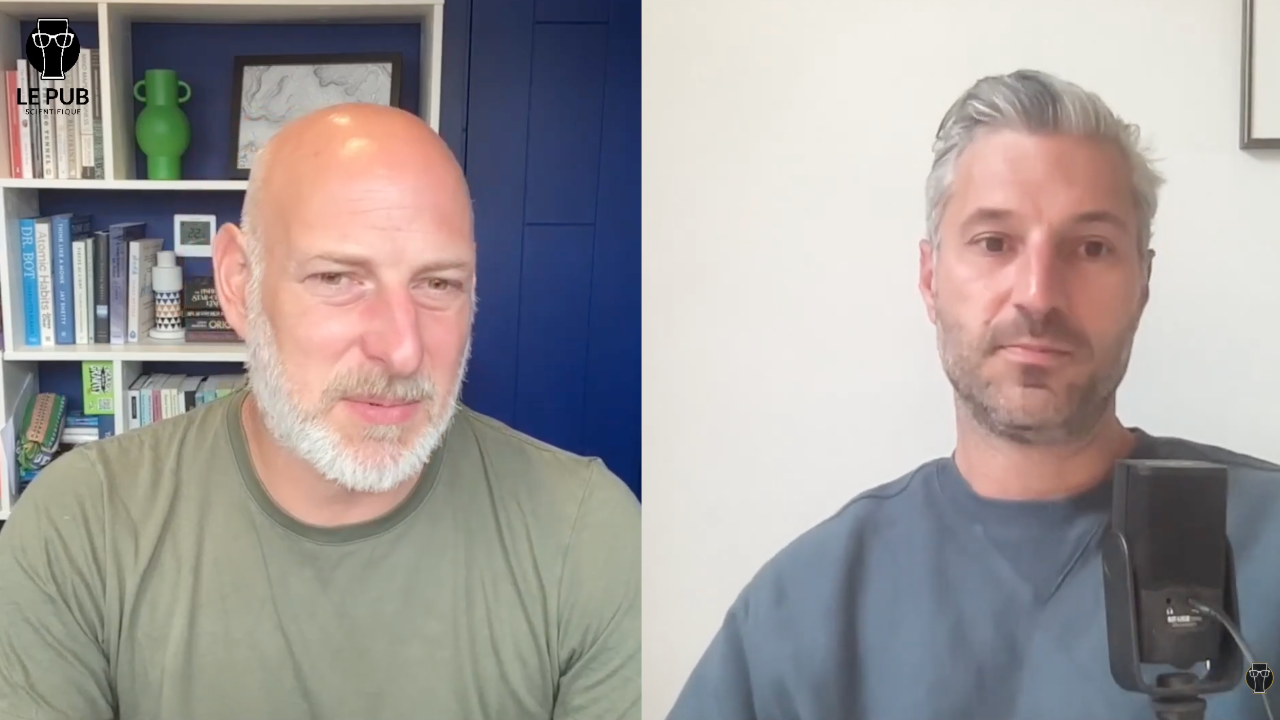
By Tim Beames & Bart van Buchem | Le Pub Scientifique
A patient is walking slowly down the corridor with her rollator. Bart says, deadpan: "Careful round this corner — you might hit the wall at that speed." She cracks up laughing.
It's a small moment. It's not a technique. Nobody would write it into a treatment protocol. But something shifts in the room. The tension drops. There's permission now — permission to not take every second of this seriously, to be a person in a clinic rather than a patient with a problem.
This is where our latest episode of The Pain Podcast begins: with the idea that playfulness, creativity, and variability aren't just nice additions to rehabilitation. They might be some of the most important things we're not doing enough of.
We're losing the ability to play
Here's an observation that's hard to argue with: we start life with roughly ninety percent play and ten percent seriousness, and by the time we're adults, that ratio has essentially flipped. Play doesn't disappear because we choose to stop. It gets squeezed out — by expectations, by responsibilities, by the creeping sense that serious problems require serious approaches.
And persistent pain is about as serious as it gets for the people living with it. So the clinic becomes another serious place, with serious assessments and serious exercises and serious conversations about what's wrong. The therapist is serious. The patient is serious. And the space for curiosity, experimentation, and surprise — the space where learning actually happens — quietly closes.
That doesn't mean every session should be a comedy show. Playfulness in a clinical setting isn't about being the funny person. It has to be authentic, it has to be appropriate, and it has to suit who you are as a clinician. If you're forcing it, the patient will feel that immediately. But if it's genuine — if it arises naturally from the relationship and the situation — it can do things that structured programmes simply can't.
Clinical scenario: walk like you're missing the bus
One of Bart's approaches draws on what he calls metaphorical movement. Rather than asking someone to walk "normally" (which, for someone with persistent pain, often means walking cautiously, protectively, monitoring every step), he'll suggest something unexpected: walk like you're missing the bus. Walk like you're trying to catch someone's attention. Walk like you've just realised you've left your keys behind.
What happens is striking. Without any biomechanical instruction, movement patterns change. The person moves differently — not because they've been told to activate a particular muscle or adopt a particular posture, but because the metaphor gives them something to embody. Their attention shifts from monitoring their body to engaging with a scenario. And in that shift, new movement strategies appear.
This isn't accidental. It works because it changes the context of the movement without changing the movement itself. The task is still walking. But the experience of walking is entirely different. And that difference — the felt sense of doing something familiar in an unfamiliar way — is where learning begins.
Tim takes a similar approach, often reaching for animals: walk like a tiger, walk like a tortoise. The point isn't the specific metaphor. It's that by stepping into something playful, the person sidesteps the habitual protective patterns that have become locked in. Even people who look deeply sceptical at first can surprise you. They try it, something shifts, and there's a moment of genuine unlocking.
Constraint-based learning: limiting options to expand them
Bart has another tool that sits beautifully alongside playful exploration: constraint-based learning. The idea is simple — you deliberately restrict one element of a task so that the person is forced to find a different way of doing it.
Close your eyes and bend forward. Stand up without using your hands. Do the same movement, but this time think only about your breathing, not your back.
These constraints are deliberately small. They don't need to be dramatic. But they do something important: they replace the constraint that's already there. Most people with persistent pain are already constrained — by their pain, by the expectation of pain, by the protective strategies they've developed over months or years. Those constraints are deeply familiar, heavily rehearsed, and extremely hard to override with verbal instruction alone.
Introducing a new, unfamiliar constraint sidesteps that entirely. The person's attention goes to solving the new problem — how do I stand up without my hands? — rather than managing the old one. And in the process, new motor strategies emerge. Different muscles fire. Different movement patterns appear. The person discovers they can do something they didn't know they could do, and that discovery carries its own therapeutic weight.
The balance, as Bart puts it, is between challenge and safety. If the constraint feels too threatening, the person falls back on their old strategies. If it's achievable but unfamiliar, it creates a space where exploration becomes possible.
The patient who exercised for ninety minutes a day
Not every patient needs more play. Some need less structure — or at least a disruption to the structure they've built.
Bart describes a pattern that will be familiar to most clinicians: the patient who arrives with a collection of exercise programmes from every therapist they've ever seen. Page after page. Ninety minutes a day, religiously followed. And nothing has changed.
His intervention, in cases like this, is deliberately provocative: you're not allowed to exercise this week. None of it. The only thing you're permitted to do is move in the morning until you feel a bit more relaxed and flexible. That's it.
The response is often immediate discomfort. "I didn't know what to do. It didn't work out." And that's exactly the point. For someone whose entire coping strategy is built around control and compliance, being asked to let go — even temporarily — is profoundly disruptive. It challenges the assumption that more structure equals better outcomes. It surfaces the question that's been buried under ninety minutes of daily exercises: is any of this actually helping, or has it just become the thing I do?
This isn't anti-exercise. It's anti-autopilot. The literature on activity and pain is clear that what you do matters less than the fact that you're doing something. Which means there's enormous room for creativity, variation, and personal preference within that. If someone wants a structured programme, that's fine — give them one. But if the programme has become a rigid, joyless ritual that they endure rather than engage with, it might be time to disrupt it.
The cartwheel principle
Tim's daughter is currently obsessed with cartwheels. But she's not doing the same cartwheel over and over. She's doing one-handed cartwheels, running cartwheels, cartwheels on grass, cartwheels on concrete, cartwheels where she changes her legs, cartwheels that are really more like something else entirely.
She's learning through variation. Every attempt is slightly different from the last. She's not following a protocol. She's exploring a landscape of possibilities, building what movement scientists would call abundance — the ability to perform a task in many different ways, adapting to different surfaces, speeds, and demands.
This is how motor learning works. Not through repetition of a single perfect pattern, but through variability — through doing the same thing many different ways until the system has a rich repertoire to draw from. Children do this instinctively. Adults, particularly adults in pain, tend to do the opposite: they narrow down to one strategy and repeat it rigidly, because that's what feels safe.
The clinical implication is significant. If we want to build resilience and adaptability in someone's movement, we need variation, not just repetition. The same squat done ten different ways teaches the body more than the same squat done perfectly a hundred times. And the same walk done as a tiger, a tortoise, and someone missing a bus teaches it more still.
Context changes everything
Tim brought up the work of Charles Spence and Heston Blumenthal during our conversation, and it's worth a brief detour because it illustrates the point beautifully.
In one experiment, Spence coloured white wine red and asked people to taste it. They reported tasting red wine flavours — blackcurrants, tobacco, strawberries — from the exact same liquid they'd previously described as tasting of lemons and melon. In another, he played the sound of crunching through headphones while people ate a crisp. When the crunch sound was louder, people rated the crisp as fresher and tastier. Same crisp. Different context. Completely different experience.
The relevance to pain rehabilitation is direct. We know from decades of research that context — the environment, the expectations, the emotional state, the social setting — shapes the experience of pain. If shifting the sound of a crunch can change how fresh a crisp tastes, it shouldn't surprise us that shifting the context of a movement can change how threatening it feels.
This is what playfulness, creativity, and variation are really doing. They're not just making sessions more enjoyable (though that matters too). They're changing the context in which movement occurs, and in doing so, changing the experience of that movement. A squat performed playfully, in a game, with a constraint, with music, with laughter in the room — that's a fundamentally different perceptual event from the same squat performed alone, at home, grimly ticking off set three of ten.
Abundance: the case for less control
We ended our conversation with the word we'd been circling all episode: abundance. It's the opposite of the rigid control that so many people with persistent pain are locked into.
Bart made an observation that's worth sitting with: many people in chronic pain have been seeking more and more control for years. Controlling their posture, their breathing, their movements, their activities. And they're exhausted by it. Keeping the body on high alert all day — monitoring, bracing, protecting — takes enormous energy. Yet the instinct, when things aren't improving, is always to try to control more, not less.
One of the most striking things Bart sees in clinic is what happens when someone is finally given permission to let go. People fall asleep. Not deep sleep, but they drop straight into a level of relaxation that their body has been craving and that their control strategies have been preventing. For many, it's a completely new experience — the discovery that their body can actually settle, given the chance.
Abundance, in a motor sense, is the ability to do things in many ways rather than one "correct" way. In a broader sense, it's the freedom to not have to control everything — to move spontaneously, breathe without thinking about it, sit without monitoring your posture. That kind of freedom isn't reckless. It's what recovery actually looks like.
Where this sits in the bigger picture
If you've been following this series, you'll see how the threads connect. In our first blog on agency, we explored what happens when pain takes control and the person stops feeling like they're in charge. In our second blog on affordances, we looked at how the world shrinks — fewer movements, fewer social connections, fewer opportunities — and how environmental enrichment can begin to reopen it.
This blog picks up where those left off. Playfulness, creativity, and variability are the tools that bring both agency and affordances back to life. They're how you help someone move differently without telling them how to move. They're how you introduce novelty without overwhelm. They're how you create the conditions where learning — real, embodied, felt learning — can occur.
And they're a reminder that rehabilitation, at its best, should be a process of discovery, not just endurance.
This blog is based on an episode of The Pain Podcast by Le Pub Scientifique. Listen to the full conversation on Podbean, Spotify, or Apple Podcasts. For clinical action plans, treatment guides, and our full library of science sessions, visit lepubscientifique.com.
Le Pub Scientifique is where pain treatment gets real. We gather the world's most respected clinicians and researchers to share practical strategies that work. No boring theory, just proven techniques from clinicians who get remarkable results.
Stay connected with news and updates!
Join our mailing list to receive the latest news and updates from our team.
Don't worry, your information will not be shared.
We hate SPAM. We will never sell your information, for any reason.